Paul Hollywood Sourdough Bread
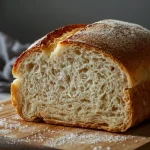
This artisan sourdough bread boasts a crisp, golden crust and a soft, airy crumb with a subtle tang. Inspired by Paul Hollywood’s techniques, it uses slow fermentation for deep flavor and perfect structure.
- Prep Time: 30
- Cook Time: 50
- Total Time: 470
- Yield: 4 1x
- Category: Breakfast
- Method: Baking
- Cuisine: Artisan Bread
Ingredients
- 1 cup active sourdough starter (100% hydration, bubbly and fed)
- 1 1/2 cups lukewarm water (filtered, at 105°F / 40°C)
- 4 cups strong bread flour (such as King Arthur Bread Flour), plus extra for dusting
- 2 teaspoons fine sea salt
- 1 tablespoon olive oil, for greasing the bowl
Instructions
- In a large mixing bowl, combine the active sourdough starter and lukewarm water. Stir vigorously with a whisk or fork until the starter is mostly dissolved and the mixture appears milky. This ensures even hydration and activates the wild yeast for optimal fermentation.
- Add the bread flour to the bowl. Using a dough whisk or your hands, mix until no dry flour remains and a shaggy, rough dough forms. Avoid overmixing at this stage to prevent developing too much gluten prematurely, which can make the dough tough.
- Sprinkle the fine sea salt evenly over the dough. With wet hands to prevent sticking, gently incorporate the salt by folding and squeezing the dough for about 2 minutes. Salt strengthens the gluten network but can inhibit yeast if added too early, so it’s added after initial mixing.
- Cover the bowl with a damp kitchen towel or plastic wrap. Let it rest at room temperature (around 70°F / 21°C) for 30 minutes. This autolyse period allows the flour to fully absorb water, improving dough elasticity and making kneading easier.
- After resting, turn the dough out onto a lightly floured surface. Knead for 10-15 minutes, using the heel of your hand to push the dough away, then fold it back. The dough is ready when smooth, elastic, and it passes the windowpane test: stretch a small piece thinly; it should not tear easily.
- Place the kneaded dough in a bowl lightly coated with olive oil, turning to coat all sides. Cover with the towel or plastic wrap. Let it rise at room temperature for 4-6 hours, or until doubled in size. Perform stretch and folds every 30 minutes for the first 2 hours: wet your hands, lift one side, and fold it over, repeating on all sides to strengthen the dough.
- Once doubled, gently turn the dough out onto a floured surface without punching it down. Shape it into a round boule by stretching the edges and tucking them under, creating surface tension. This helps the bread hold its shape and rise properly during baking.
- Place the shaped dough seam-side up in a well-floured banneton or a bowl lined with a floured kitchen towel. Cover and let proof at room temperature for 1-2 hours, or until it passes the finger dent test: gently press a finger into the dough; it should slowly spring back, leaving a slight indent.
- Preheat the oven to 450°F / 230°C. Place a Dutch oven or baking stone inside to heat for at least 30 minutes. A preheated vessel creates steam, which is crucial for a crispy crust and good oven spring.
- Carefully transfer the proofed dough to a piece of parchment paper. Score the top with a sharp lame or knife in a pattern, about 1/4 inch deep. Scoring controls where the bread expands during baking and adds an attractive finish.
- Using the parchment paper as a sling, lower the dough into the preheated Dutch oven. Cover with the lid and bake for 20 minutes. The covered bake traps steam, allowing the bread to rise fully and develop an initial set crust.
- After 20 minutes, remove the lid and reduce the oven temperature to 400°F / 200°C. Continue baking for another 25-30 minutes, or until the crust is deep golden brown and sounds hollow when tapped. For accuracy, check the internal temperature with a thermometer; it should read 210°F / 99°C.
- Remove the bread from the oven and transfer to a wire rack. Allow it to cool completely for at least 2 hours before slicing. Cooling allows the crumb to set and prevents a gummy texture, ensuring perfect slices.
- Once cooled, slice and serve. Store any leftovers as per the notes for best freshness.
Notes
Store the bread in a paper bag at room temperature for up to 3 days to maintain crust crispness. For longer storage, wrap tightly in plastic wrap and freeze for up to 3 months. To reheat, place frozen or room temperature bread in a preheated 350°F / 175°C oven for 10-15 minutes until warm and crispy.
Nutrition
- Calories: 580
- Sugar: 0.5g
- Sodium: 1150mg
- Saturated Fat: 1g
- Carbohydrates: 114g
- Fiber: 4g
- Protein: 15g
- Cholesterol: 0mg
Keywords: paul hollywood sourdough, sourdough bread recipe, artisan bread, homemade sourdough, slow fermented bread, bread baking, crusty sourdough, tangy bread, british baking, weekend project, baking from scratch, sourdough loaf
Find it online: https://britishrecipes.uk/paul-hollywood-sourdough-bread/